

Particle Insight Raptor – Bench-Top
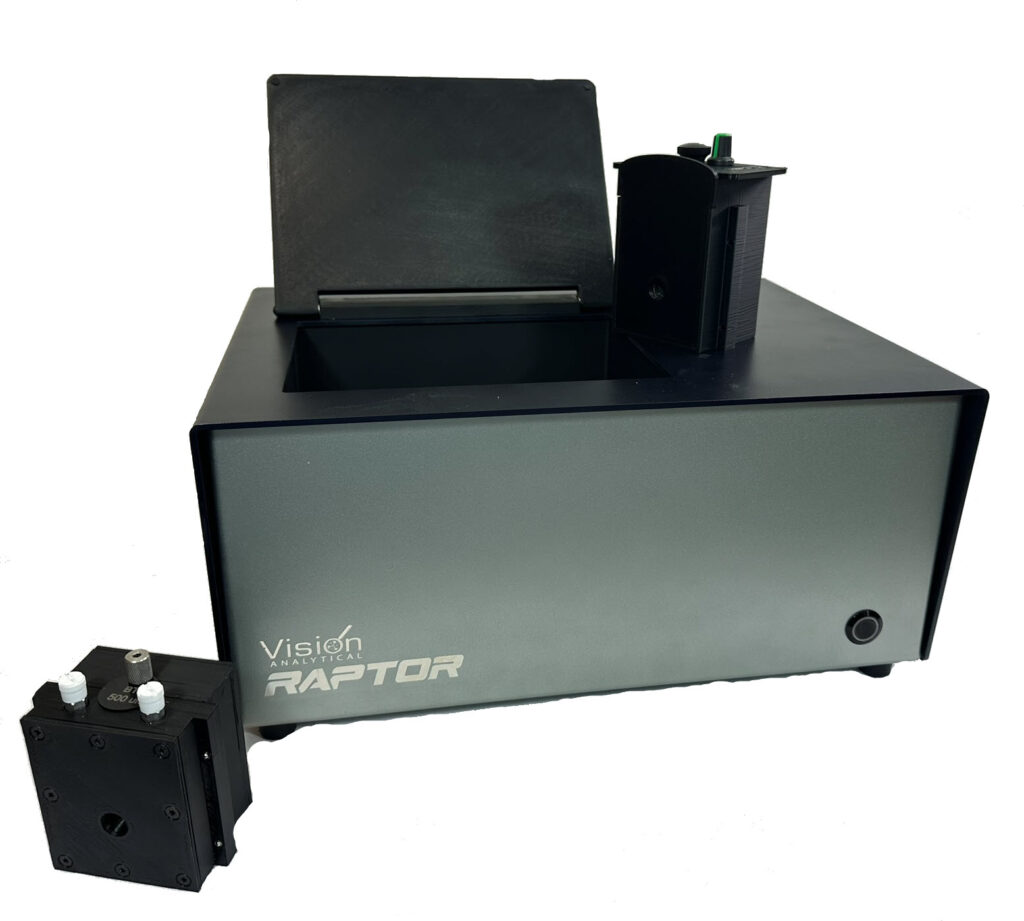
Raptor Bench-Top Particle Size & Shape Analyzer (Coming Soon)
The Raptor Bench-Top system is the next-generation dynamic image analysis platform from Vision Analytical, designed for laboratories and production environments that require high-confidence particle size and shape characterization — not size alone.
Dynamic Image Analysis (DIA) provides high-resolution particle images along with size, shape, and concentration data, supporting better insight into particle morphology and improved decision-making for quality control and research.
What to Expect
The Raptor Bench-Top is being prepared for launch, and additional details including specifications, configuration options, and application examples will be published soon.
Want early information or a preview?
If you’d like to evaluate the Raptor Bench-Top for your application, we can share available information now and discuss how DIA may support your workflow.

Single run summary listing
Use this feature to see a concise listing of statistics for any or all measures from a single sample, in XLS format. First, the applicable size range may be narrowed if necessary. Then select the measures and statistics to include. Then click Create File to create the XLS file.
Multirun summary listing
The Multirun Summary is a way to show the major results from a series of runs in a concise format. Once the series of runs is selected, choose which measures to report on: Then select the statistics to report: Finally, click Create Worksheet to create the XLS file:
Cumulative Percents
The “percent <= and >” window reports what fraction of the sample is less than and greater than four sizes, which you enter into the window on the left side. With the distribution shown, 8.19 % of the sample’s particles, by particle count (“number”) are below 10.0 microns in size, and 91.7 % are between [...]
Comprehensive Statistics
The Comprehensive Statistics window characterizes the sample in greater detail, using commonly-accepted statistics for histogram data. The Arithmetic values come from the original data and correspond visually to what the histogram would look like on a linear size axis. Geometric stats reflect the appearance of the distribution on the log axis. Mean is the average [...]
Surface area and volume weighting
Sometimes you need to know how particles are distributed along the size axis with respect to surface area or volume. For example you might need to know how much of the sample volume is between two specific particle diameters. The Particle Insight computes surface area and volume for each particle. The calculation is done separately [...]