
Can the Mastersizer 3000 Measure Particle Shape?
Understanding the Limitations of Laser Diffraction and the Value of Particle Imaging
The Malvern Mastersizer 3000 is one of the most widely used laser diffraction particle size analyzers in laboratories worldwide. Researchers and engineers rely on this technology to measure particle size distributions quickly and accurately, making laser diffraction an essential tool in industries ranging from pharmaceuticals and additive manufacturing to chemicals, battery materials, and advanced powders.
Laser diffraction instruments like the Mastersizer provide highly reliable particle size data, but a common question often arises among scientists using this technology:
Can the Mastersizer 3000 measure particle shape?
The short answer is no. Laser diffraction systems measure particle size distributions but do not directly measure particle shape or provide particle images.
Understanding this limitation is important because particle shape often plays a critical role in determining how materials behave. In many real-world applications, particle morphology can influence flow behavior, packing density, dissolution rates, and processing performance.
In this article, we will explore:
-
What the Mastersizer 3000 actually measures
-
Why laser diffraction cannot measure particle shape
-
How particle shape influences material behavior
-
The limitations of laser diffraction particle size analysis
-
How dynamic particle imaging can complement laser diffraction measurements
What the Mastersizer 3000 Measures
Laser diffraction instruments such as the Malvern Mastersizer 3000 measure particle size distribution by analyzing how particles scatter light when illuminated by a laser beam.
As particles pass through the laser, they scatter light at different angles depending on their size. The instrument measures this scattering pattern and applies mathematical models to calculate the particle size distribution.
Laser diffraction offers several advantages:
-
Rapid measurement of large particle populations
-
Excellent reproducibility
-
Wide measurement range
-
Robust particle size distribution data
These capabilities make laser diffraction one of the most widely used particle size measurement techniques in industrial and research laboratories.
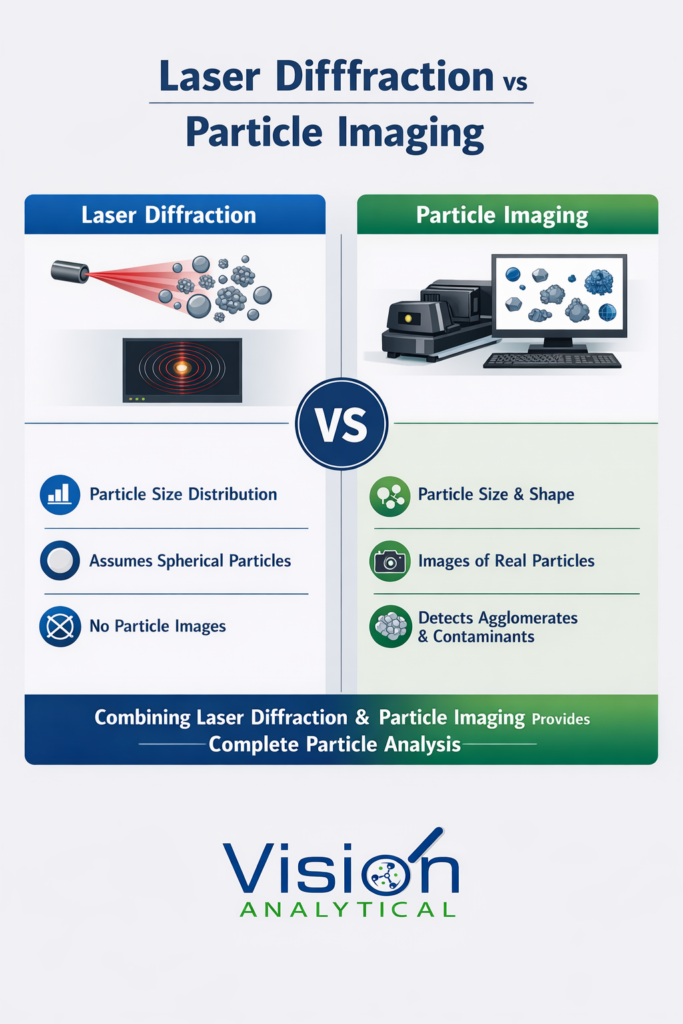
However, laser diffraction models assume that particles behave like equivalent spheres when calculating particle size.
This assumption introduces a key limitation.
Why Laser Diffraction Cannot Measure Particle Shape
Laser diffraction does not capture images of particles. Instead, it interprets light scattering patterns and converts them into particle size distributions using optical models.
Because of this, laser diffraction cannot directly determine:
-
Particle shape
-
Particle morphology
-
Particle orientation
-
Particle images
-
Agglomerate structure
-
Contaminants or foreign particles
Two particles with completely different shapes may produce similar scattering patterns.
For example, the following particles might produce similar diffraction signals:
-
Spherical particles
-
Fibers
-
Platelets
-
Irregular fragments
Even though their shapes are very different, the light scattering patterns may lead to similar calculated particle sizes.
This means that particle size distributions alone may not fully describe a particle system.
Why Particle Shape Matters
Particle shape often has a strong influence on how materials behave during processing or in final products.
Important material properties influenced by particle morphology include:
-
Powder flowability
-
Packing density
-
Filtration behavior
-
Surface area
-
Reaction rates
-
Dissolution characteristics
In many industries, understanding particle shape is essential.
Pharmaceutical formulations
Particle shape can influence drug dissolution rates and bioavailability.
Additive manufacturing powders
Particle morphology affects powder flow behavior and layer uniformity.
Catalyst particles
Surface geometry may influence reaction efficiency.
Filtration systems
Particle shape affects filter clogging and filtration efficiency.
Because particle morphology plays such a significant role in material performance, relying only on particle size distribution may not provide a complete understanding of a material.
Limitations of Laser Diffraction Particle Size Analysis
While laser diffraction is an extremely powerful technique, several common measurement challenges arise when particle shape or particle structure influences the scattering signal.
These limitations are frequently encountered by scientists working with particle systems.
Agglomerates
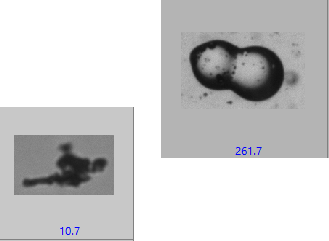
Agglomeration occurs when multiple particles stick together, forming clusters.
Laser diffraction may interpret these clusters as larger individual particles, which can distort the particle size distribution.
Without particle imaging, it can be difficult to determine whether large particles are:
-
True large particles
-
Agglomerates of smaller particles
Hidden fines
Small particles can sometimes be hidden inside agglomerates or overshadowed by larger particles in scattering measurements.
This may cause fine particle populations to appear less prominent in the particle size distribution.
Contamination
Foreign particles or debris can influence particle size measurements without being obvious in the data.
Particle imaging allows users to visually identify contamination that might otherwise go unnoticed.
Non-spherical particles
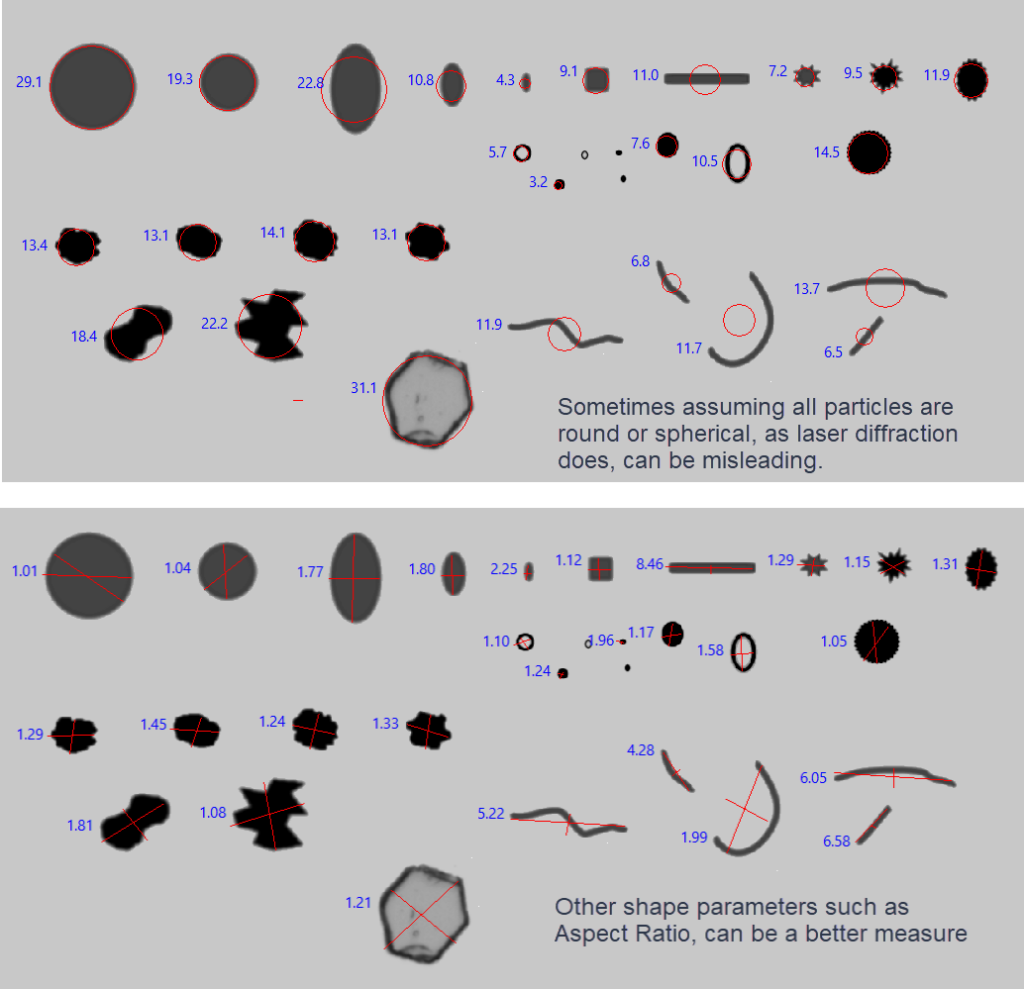
Laser diffraction models assume spherical particles when calculating particle size.
Materials with irregular shapes, fibers, or platelets may produce scattering patterns that lead to misleading particle size interpretations.
How Dynamic Image Analysis Complements Laser Diffraction
One solution to the limitations of laser diffraction is to combine particle size measurements with dynamic particle imaging.
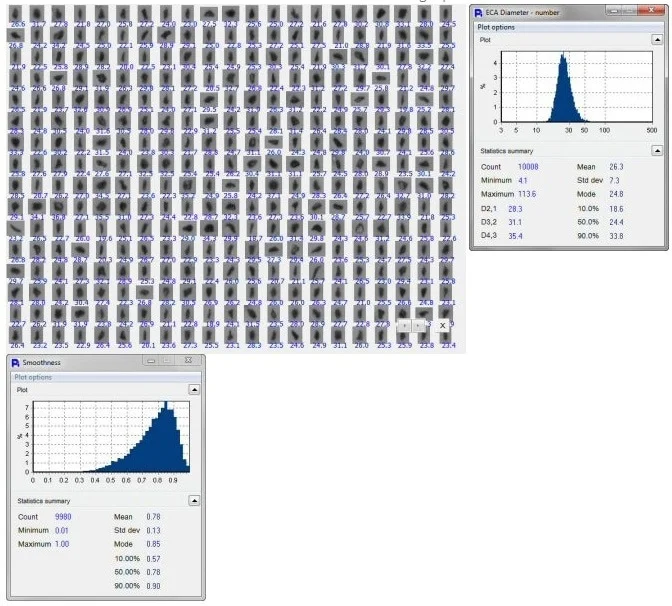
Dynamic image analysis captures images of individual particles while they flow through a measurement cell.
This technology provides additional information such as:
-
Particle shape descriptors
-
Particle morphology
-
Particle concentration
-
Agglomerate identification
-
Contamination detection
Unlike static microscopy methods, dynamic imaging analyzes large numbers of particles rapidly, generating statistically meaningful particle populations.
This combination of particle size and particle shape data provides a more complete characterization of particle systems.
Adding Particle Imaging to the Mastersizer 3000
Dynamic imaging technology can be used alongside laser diffraction instruments to enhance particle characterization.
One such solution is Hydro Insight, a dynamic image analysis system designed to complement the Mastersizer 3000.
Hydro Insight provides:
-
Real particle images
-
Particle shape analysis
-
Particle concentration measurements
-
Agglomerate detection
When used alongside laser diffraction measurements, particle imaging allows scientists to visually confirm particle morphology and better interpret particle size data.
Learn more about the Hydro Insight system here:
https://particleshape.com/newsite/hydro-insight-for-malvern-mastersizer-3000-particle-size-shape/
Additional information about particle imaging technology can be found here:
https://particleshape.com/how-particle-shape-analysis-compliments-size-measurements/
Example: Troubleshooting Particle Size Measurements
In many laboratories, unexpected particle size distributions can be difficult to interpret.
For example, an unusually broad particle size distribution may be caused by:
-
Agglomeration
-
Sample preparation issues
-
Contamination
-
Irregular particle shapes
Laser diffraction alone may not reveal the underlying cause of these measurement anomalies.
Dynamic image analysis provides visual evidence that helps scientists diagnose these issues quickly.
By observing particle images, researchers can determine whether the distribution is caused by agglomerates, irregular shapes, or unexpected contaminants.
Seeing What Laser Diffraction Cannot
Particle imaging technology allows scientists to directly observe particle morphology and particle behavior.
The following video demonstrates how particle imaging can reveal particle characteristics that are not visible in particle size distribution data.
Another example shows how imaging can reveal particle structures and agglomerates that cannot be detected using laser diffraction alone.
These demonstrations illustrate how combining particle size and particle imaging provides a deeper understanding of particle systems.
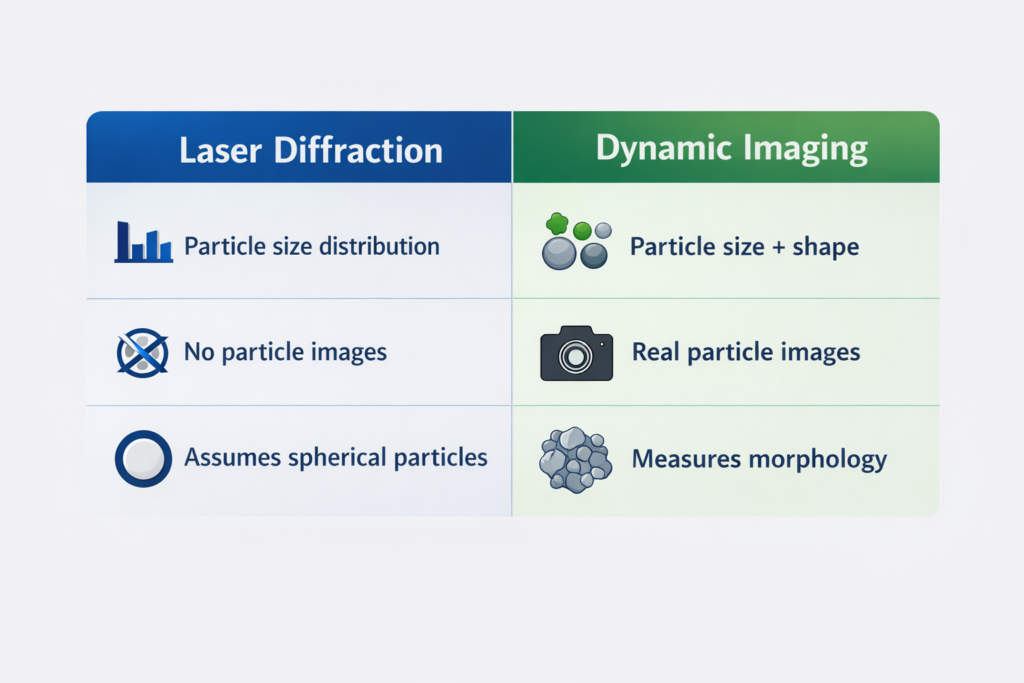
Particle Size vs Particle Shape
Particle size distribution remains one of the most important measurements in particle characterization.
However, particle shape analysis adds a complementary dimension to this measurement.
Together, these techniques provide a more complete understanding of particulate materials.
Laser diffraction provides:
-
Particle size distribution
-
Rapid population analysis
Dynamic image analysis provides:
-
Particle images
-
Particle morphology
-
Agglomerate identification
-
Particle concentration
Combining these methods allows researchers to interpret particle size data with greater confidence.
The Future of Particle Characterization
Modern laboratories increasingly use multiple complementary techniques to characterize particle systems.
Laser diffraction remains a powerful and widely adopted technology for particle size analysis.
However, particle imaging techniques are becoming increasingly important for understanding particle morphology and troubleshooting measurement challenges.
By combining laser diffraction with dynamic image analysis, scientists can obtain both particle size distributions and particle shape information, providing a more complete characterization of particulate materials.
Conclusion
The Malvern Mastersizer 3000 is one of the most powerful and widely used instruments for measuring particle size distributions using laser diffraction.
However, laser diffraction alone cannot measure particle shape or particle morphology.
Because particle shape can significantly influence material behavior, combining particle size analysis with dynamic image analysis can provide deeper insight into particle systems.
By integrating particle imaging alongside laser diffraction measurements, scientists can visualize particles, identify agglomerates, detect contamination, and better interpret particle size distributions.
This combination of techniques allows researchers and engineers to gain a more complete understanding of the materials they work with every day.
Want to Learn More About Dynamic Image Analysis?
Dynamic Image Analysis is a powerful particle measurement technique that combines particle counting with particle imaging, providing valuable insights into particle size, shape, and concentration.
To learn more about how Dynamic Image Analysis works and where it is used, explore additional educational resources on ParticleShape.com.
Reach out here: Contact Vision Analytical