
How are they different? Understanding the advantages, limitations, and appropriate applications of each particle sizing technique.
Fine particles play essential roles in determining the characteristics of both natural and man-made materials and have considerable influence on processes such as dissolution, adsorption and reaction rate. These particle-related characteristics must be controlled in order to optimize the desired effects, and efficient control requires measurement.
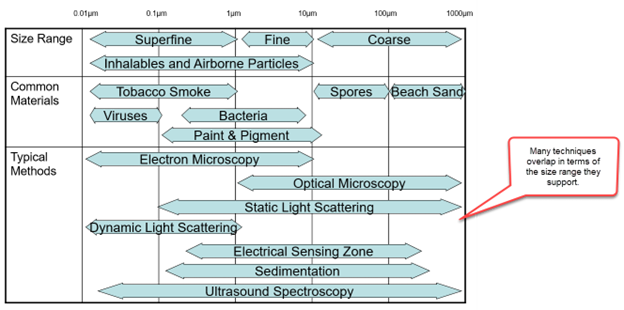
There are multiple techniques for determining the same particle dimension and each has its advantages and disadvantages. Selecting a technique that is inappropriate for the application can have a deep impact on the quality of the measurement you obtain.
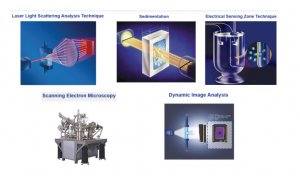
Uses Stokes’ law to measure particle velocity as it relates to particle size. Data results are displayed assuming all particles are round in shape.
Particles suspended in a conductive liquid pass through a narrow orifice where particles are counted and voltage change is proportional to particle volume.
A direct measurement of every particle by taking images as they pass through a detection zone. Provides size as well as shape information.
Arithmetic Mean, Geometric Mean & Mode
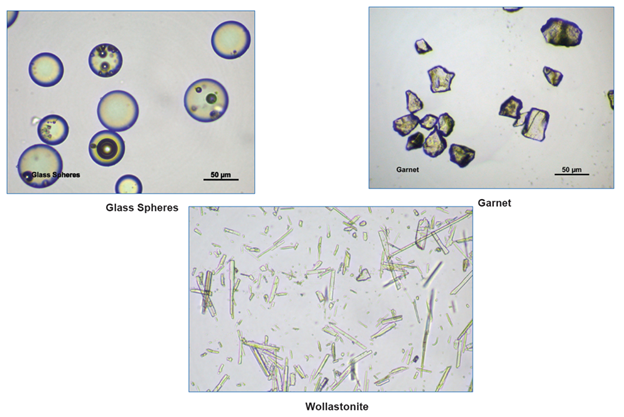
The median (D50) results are very similar for all the particle size methods. Close agreement is expected since glass beads are nearly spherical and the various methods relate size to an equivalent sphere.
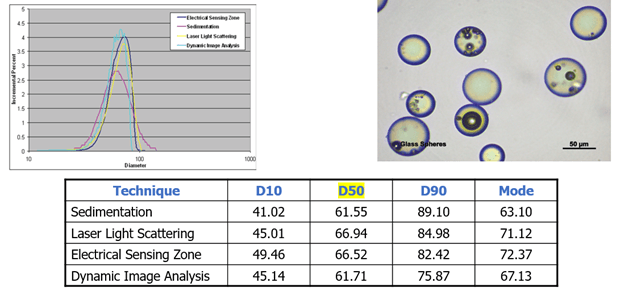
Nearly Spherical Particles
Results are larger with flowing techniques (light scattering and image analysis) than with instruments sensitive to equivalent spherical diameter. The diagonal distance between opposite corners is longer than the diameter of an equivalent volume sphere by about 30%.
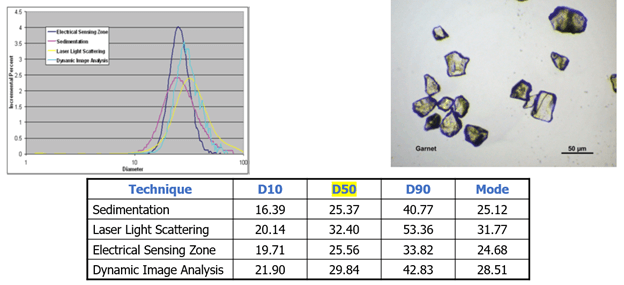
Very little agreement in D50 values. The light-scattering technique sees the largest particle dimension. The same flow and shape effects from garnet are more pronounced with rod-shaped particles.
Each technique has unique physical measurement characteristics that impact results, especially with non-spherical particles.
The velocity of particles falling in a liquid is based on the drag on envelope surface of the particle. Material properties such as skeletal density can impact particle size — heavy particles sediment faster.
The correct refractive index of the sample and medium is critical. Both real and imaginary refractive indexes may be needed depending on size and the optical mathematical model used.
Measures displaced particle volume. No specific properties are needed beforehand, but a round particle and an irregular particle will have different volume displacements.
Measures based on 2-dimensional projected cross section areas of particle images. No specific optical properties are required to make a calculation.
Number-based techniques (dynamic image analysis and electrical sensing zone) can report both volume-weighted and number-weighted distributions. When comparing, use the same weighted statistic across techniques.
Different techniques may give slightly different results — neither is wrong. Differences increase as particle shapes become less round.
Understanding the shape properties of your particles helps you interpret results correctly, regardless of the technique used.