

Knowledge Center

Welcome to our Knowledge Center. Here our goal is to offer the user an easy way to navigate to all of our educational content.
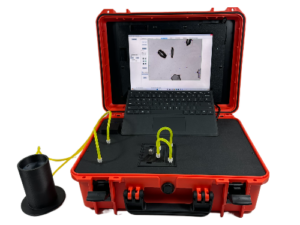
Key Insights into Water-Based Drilling Mud Through Image Analysis
Water-based drilling muds are a critical component in the drilling industry. They offer a balance of efficiency, cost-effectiveness, and environmental safety. The physical characteristics of these muds, such as particle size and shape, play a pivotal role in their performance. Image analysis can help decipher the properties of these muds.
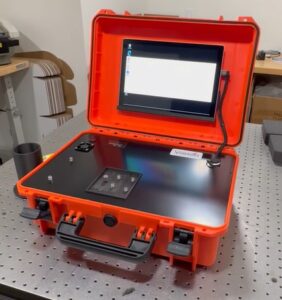
Next-Gen Field and Lab Particle Analysis: Portable and Precise
Choices are often limited when it comes to particle analysis. Your sample, and indeed, application, can reduce the scope of equipment variability. Ultimate precision is typically only achievable in the lab. Yet generalizability to real-life contexts often requires a natural setting. The trouble with field analysis is its inherent lack of control. It is generally conducted among larger samples and is thus more time-consuming than lab-based particle analysis.

Fuel and lubricant particle analysis with a view
In the world of analyzing fuel and lubricants, the use of particle counters is widespread and essential. Numerous reporting standards exist to offer guidance on limits of contamination. If you are in this industry, then you are aware of these different contamination codes and how typical particle counters work for the measurement of contamination particles.

Elevating Drilling Efficiency with Advanced Particle Size and Shape Analysis
In the dynamic world of drilling operations, achieving peak efficiency is a complex and multifaceted challenge. A critical but often overlooked aspect in this realm is the role of advanced particle size and shape analysis. This innovative approach to particle analysis revolutionizes our understanding and optimization of materials in drilling processes.

Exploring Water Quality through Particle Concentration Measurements
Water quality hinges significantly on understanding and managing particle concentration within a given water supply. The Particle Insight Raptor Portable, a recently launched instrument, has emerged as a crucial tool in conducting meticulous particle concentration measurements. This article delves into the technicalities and applications of this instrument, shedding light on its capabilities in analyzing water quality, especially in wastewater samples.

How Lithium & Graphite Battery Particle Shape Complements Size
In the rapidly advancing world of battery technology, quality control and performance optimization are paramount. Historically, the particle size of powders used in batteries, especially lithium and graphite, has been the primary focus. However, recent research and industry trends have illuminated the significance of another parameter: particle shape.

Can Particle Imaging Unlock More Durable Sands for Hydraulic Fracturing?
Hydraulic fracturing, or fracking, has revolutionized the energy industry, unlocking vast reserves of previously inaccessible natural gas and oil. This innovative technique involves injecting a high-pressure fluid into a wellbore to create small fractures in deep rock formations, allowing natural gas or oil to flow more freely. However, maintaining the integrity of these fractures is a significant challenge facing the industry.
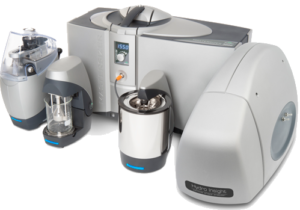
Maximizing Particle Analysis: How Particle Shape Analysis Complements Particle Size Analysis
Particle analysis is an important field with broad applications in numerous industries. The demand for reliable and accurate particle analysis techniques has led to the development of various automated tools for particle size analysis. These tools report the particle size in terms of equivalent spherical diameter, a necessary representation for irregularly shaped particles.

Significance
The Significance of Particle Shape Investigating raw materials for particle size distribution is a very common practice in many industries. Particle size measures have become the standard inspection criteria for incoming materials, and outgoing products that we all use every day. Particle size is the main way powders and other granular materials are quantized. But, [...]
Particle Characterization
Basics of Particle Characterization Size and shape are the attributes that most affect the behavior of particulate substances. Spherical beads are easily characterized by a single size measure – diameter. More irregular shapes are more difficult to characterize, but for powders used in manufacturing it is necessary to find a small set of numbers that [...]
Specifications
Specifications System: System type: imaging; images are analyzed in real time as they are captured. Particle size range: Diameter measures: 2 to 400 microns Width measures: 5 to 100 microns Length measures: 5 to 1000 microns Sample run time (25,000 particles): 100 seconds, typical Images per run: 200 to 400, typical Computer: Minimum system requirements: [...]
Custom Engineering
Instrument installations sometimes require customization to adapt to the needs of user’s processes. Typical requests include adapting our Particle Insight to an on-line process, or to develop custom sample cells needed for specific applications, or new software features to meet the needs of users and market needs. In some cases, these custom engineering projects become [...]
PARTICLE SHAPE APPLICATION EXAMPLE: Ocean Sediments
The challenge Ocean floor sediments are studied by marine scientists. They are composed of fine particles of sand, clay, volcanic ash, minerals and organics. The small grain size makes measurement a challenge. Two different kinds of sediment were studied for this example. Applicable measures Measure Equivalent Circular Area Diameter Equivalent Elliptical Area Width Equivalent Elliptical [...]
PARTICLE SHAPE APPLICATION EXAMPLE: Portland Cement
The challenge Portland cement is a controlled chemical combination of calcium, silicon, aluminum, iron and small amounts of other ingredients to which gypsum is added in the final grinding process to regulate the setting time. Lime and silica make up about 85% of the mass. Common among the materials used in its manufacture are limestone, [...]
Visit our YouTube Page
Particle Insight Raptor Portable Series
- Raptor – General Brochure
- Raptor – Fuel and Lubrication Edition
- Raptor – ASTM 7596-14 Compliance Document
- Raptor – Oil and Gas Edition
Hydro Insight Series
Particle Insight Sentinel Series
If you are looking for any specific document or information that you cannot find, please contact us and we will be able to answer your questions or even create any needed documentation.