
Most lost circulation material (LCM) specifications are written around particle size. Size is only half the story. Two LCM blends with the same D50 can behave very differently downhole if one is mostly fibers and the other is mostly granules. How a particle is shaped decides how it bridges a fracture, how tightly it packs, how it holds up in the mud system, and even how it gets measured.
This guide covers the main LCM shape types, the shape parameters that matter, why traditional size methods misreport irregular particles, and how dynamic image analysis measures shape directly. For the size side of the story, including bridging rules of thumb, see our companion article on LCM particle size and a real dry-powder test of lost circulation materials.
The Three LCM Shape Types and How Each One Seals
LCM products are usually grouped by shape, because shape determines how the material works in a loss zone.
Granular LCM
Granular materials, such as sized calcium carbonate, ground nut shells, and graphite, are roughly equant: their length, width, and thickness are similar. They do the core bridging work, lodging at the fracture mouth and packing into a framework. Their size distribution relative to the opening matters most, but angularity and surface roughness also affect how tightly they lock together.
Fibrous LCM
Fibers, such as cellulose and mineral fibers, are long and thin. They mat across an opening and form a net that catches granular particles and fines. A small fraction of fibers can make a granular blend seal much faster. Their key property is length relative to width, so a fiber that has been chopped short in the pumps no longer does the same job.
Flaky LCM
Flakes, such as mica and cellophane, are thin and flat. They lie across an opening or against the fracture face and overlap like shingles, reducing permeability. Their effectiveness depends on their face area and thickness, two dimensions a single size number can’t capture.
Most field blends combine two or three of these types. Knowing the proportions in a blend, and whether those proportions hold up during circulation, is where shape analysis earns its keep.
Shape Parameters That Matter for LCM
Dynamic image analysis measures each particle’s outline and calculates shape parameters from it. These are the ones most useful to a drilling fluids engineer:
- Aspect ratio (width divided by length, or its inverse): separates fibers and elongated particles from granular ones. A fiber class can be defined, for example, as particles longer than three times their width.
- Circularity: how closely the outline resembles a circle. Low circularity flags irregular, angular, or fibrous particles.
- Convexity (also called solidity): compares the particle’s area to the area of its outline stretched tight around it. Low values flag rough, jagged, or branched particles, which tend to interlock more strongly.
- Length and width separately: for fibers, length is the dimension that matters for matting. For granules, width is closer to how the particle bridges.
Combined with size, these parameters let you sort a blend into classes such as granular, fibrous, and flaky, then report how much of each is present.
Why Size-Only Methods Mislead
Traditional particle size methods weren’t designed for irregular particles, and LCM is about as irregular as particles get.
- Laser diffraction reports every particle as an equivalent sphere. A long fiber is reported as a sphere somewhere between its width and its length, which smears fibers across the size distribution and hides how many there are.
- Sieve analysis sorts particles by whether they fit through an opening. Fibers pass lengthwise and flakes pass on edge, so both are reported as smaller than they act in a fracture.
The result is a size distribution that looks reasonable on paper but doesn’t describe the blend that actually reaches the loss zone.
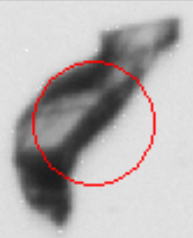
Dynamic image analysis captures an image of every particle, so size and shape are measured from the particle itself. The thumbnail above shows a single analyzed particle. Any of the thousands of particles in a run can be viewed the same way, which makes it easy to confirm what a “fibrous” or “rough” class really contains.
Shape Changes in the Field
LCM shape doesn’t stay constant once it’s in the mud system. Fibers get chopped shorter by shear in pumps and bit nozzles, flakes fold and break, granular materials round off or fracture, and solids control equipment removes some fractions more than others. A blend that went in with the right mix of fibers and granules may not have it after several circulations.
Measuring LCM in reconditioned mud, not just in fresh product, shows which shape classes are being lost. Reporting concentration by shape class tells field engineers which material to add back, and how much, to keep the blend working. A portable instrument makes this practical at the rig site rather than only in the lab.
Measuring LCM Shape with the Raptor
The Raptor Oil and Gas Edition from Vision Analytical uses dynamic image analysis to measure size and shape for every particle, in wet or dry dispersion. Its LCM configuration covers 20 to 2,500 µm. With it, you can:
- Image every particle instead of relying on a statistical size estimate.
- Classify particles as fibrous, flaky, or granular using aspect ratio, circularity, and convexity.
- Report concentration by shape class, in fresh product or reconditioned mud.
- Click into any class and review the actual particle images.
Watch LCM Shape Analysis in Action
This video shows LCM particles being imaged and classified by shape.
Frequently Asked Questions
What are the main types of lost circulation material by shape?
LCM is usually grouped as granular (such as calcium carbonate, nut shells, and graphite), fibrous (such as cellulose and mineral fibers), and flaky (such as mica and cellophane). Granular materials do most of the bridging, fibers mat across openings and hold the bridge together, and flakes overlap to reduce permeability. Most field blends combine more than one type.
Why does particle shape matter for LCM performance?
Shape controls how particles bridge, interlock, and pack in a fracture. A blend with the right size distribution can still seal poorly if it lacks fibers to hold the bridge together, or if its fibers have been chopped too short in circulation.
Can laser diffraction measure LCM shape?
No. Laser diffraction reports each particle as an equivalent sphere, so it can’t tell fibers, flakes, and granules apart, and it misreports the size of elongated particles. Dynamic image analysis measures shape directly from images of each particle.
Which shape parameters are most useful for LCM?
Aspect ratio separates fibers from granules, circularity flags irregular particles, and convexity flags rough or jagged particles that interlock strongly. Length and width measured separately are also useful, especially for fibers.
Better Shape Data, Better LCM Selection
Size tells you whether particles can bridge an opening. Shape tells you how well that bridge will hold. Measuring both lets drilling fluids engineers choose the right blend for a formation, verify what’s actually in a product, and track how a blend changes in the mud system. For more on how particle analysis supports drilling performance, see elevating drilling efficiency with advanced particle size and shape analysis.
Test Your Own LCM Samples
Want to see the shape profile of your LCM blend or reconditioned mud? Talk to our applications team about a sample analysis, or explore the Raptor Oil and Gas Edition.