
APPLICATION NOTE: AN-017
Cellulose Fiber Shape Analysis — Length, Width, Aspect Ratio & Curl
Introduction
Cellulose fibers derived from natural sources are widely used as thickening agents in consumer and industrial products — including cosmetics, shampoos, pharmaceuticals, and food ingredients. The performance of these fibers as thickening agents is directly influenced by their physical geometry: fiber length, width, aspect ratio, and curl all affect the viscosity of the final product in ways that a single size measurement cannot predict.
Analyzing fibers using size-only particle size analyzers is therefore misleading. Conventional techniques assume all particles are spherical and report a single equivalent diameter — a result that bears little relationship to how a fiber behaves in a formulation. To properly qualify cellulose fibers for thickening applications, Dynamic Image Analysis is needed. It measures fibers by their true geometry and provides thumbnail images of each particle for visual confirmation.
Background — Why Cellulose Fiber Geometry Matters
Cellulose fibers do not behave like spherical particles. Their elongated shape means they interact with each other and with the surrounding medium in ways governed by length and curl, not diameter. A population of fibers with the same average width but longer lengths will produce a higher-viscosity product. Fibers with greater curl create more entanglement and resistance to flow. These are process-critical distinctions that incoming quality control must be able to detect and quantify lot to lot.
Without shape data, manufacturers cannot reliably predict or control the viscosity of products that use cellulose as a functional ingredient.
Applicable Measures
Dynamic Image Analysis with the Raptor BenchTop captures four fiber-specific parameters for cellulose fiber characterization:
| Measure | Range of Acceptance |
|---|---|
| Fiber Width | 5 – 500 microns |
| Fiber Length | 10 – 1,000 microns |
| Fiber Aspect Ratio | 1.0 – 50.0 |
| Fiber Curl | 0 – 1.00 |

Representative cellulose fiber particles from the analyzed sample.
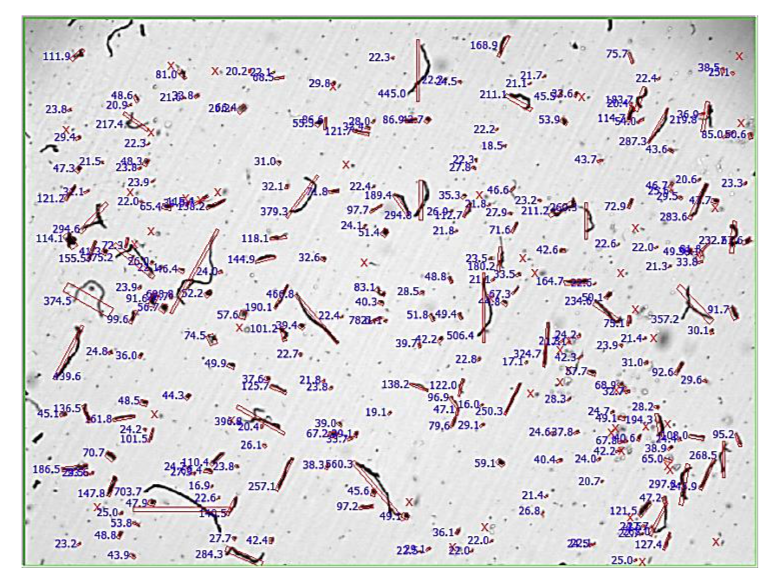
Fiber width, length, aspect ratio, and curl as measured by the Raptor BenchTop fiber shape model.
Experimental
Fibers of this type are first suspended in isopropanol, which prevents rapid dissolution, and then thoroughly mixed to ensure a representative subsample. Because longer fibers typically orient themselves along the direction of flow, the instrument is capable of measuring fiber lengths greater than the flow cell width. The fiber shape model aligns each long, narrow fiber and records Length, Width, and Aspect Ratio from the bounding rectangle of the aligned particle.
Fiber Width shows symmetry around the average of 16 microns, indicating consistent diameter across the population. Fiber Length shows an acute increase followed by a near-linear decrease to 500 microns on a log scale — a distribution shape that does not follow typical particle size distribution patterns and would be poorly represented by conventional sizing methods. Fiber Aspect Ratio averages 7.7, with the largest observed value around 50. Fiber Curl is an index of straightness: a value of 1.0 represents a perfectly straight fiber, with lower values indicating increasing curvature. Many customers have used Fiber Curl as a direct process control parameter for viscosity — a use case that is unique to Dynamic Image Analysis and not available with any other automated sizing technique.
Why These Parameters Matter for QC
Each of the four fiber-specific measurements can be used independently as an incoming quality control specification:
- Fiber Width — controls consistency of raw material diameter across lots
- Fiber Length — detects fines or overlong fibers that affect viscosity
- Fiber Aspect Ratio — quantifies elongation relevant to thickening performance
- Fiber Curl — directly correlates to viscosity in formulations where cellulose is used as a functional thickener
Because the analysis is automated and measures thousands of particles in minutes, it is practical for routine QC — something manual microscopy cannot match at production scale.
Conclusion
Cellulose fiber shape analysis requires a measurement technique that can capture the full geometric complexity of fibrous particles. Dynamic Image Analysis with the Raptor BenchTop provides length, width, aspect ratio, and curl in a single automated measurement — giving formulators and QC teams the data they need to control product viscosity and qualify incoming raw materials.
For fiber analysis in field or portable applications, or for fiber characterization in industrial fluids, see AN-001 Fiber Particle Shape Analysis.
For further reading on fiber measurement methodology, the NIOSH Measurement of Fibers guide and the Fiber Shape, Structure and Surface Texture article provide useful background.