
APPLICATION NOTE: AN-002
The Importance of Random Orientation When Measuring Particle Shape
Introduction
Particle shape is increasingly recognized across industry as a critical parameter for monitoring materials and controlling manufacturing processes. In many applications, the circularity, smoothness, or elongation of particles directly affects flowability, packing efficiency, and final product performance. For those who have recognized that particle irregularity impacts both manufacturability and efficacy, the question is not whether to measure shape — it is how to measure it accurately.
The answer depends critically on particle orientation during measurement. A shape analysis system that allows particles to present only their largest face to the detector will systematically underreport dimensional variation and produce results that do not reflect how particles behave in a real process. Random orientation — where particles are free to present any face to the detector — is the only approach that captures the full three-dimensional character of an irregular particle population.
Background — The Orientation Problem
Microscopy, also known as static image analysis, orients particles so that the largest area faces the viewing point. This is a consequence of how particles settle on a slide under gravity. While this approach may provide a general impression of particle shape, it is insufficient for process control because it systematically biases the measurement toward one orientation.
Dynamic Image Analysis per ISO 13322-2 solves this by suspending particles in a flowing liquid and capturing images as they pass through the detection zone in free suspension. Because particles are not constrained to a surface, they present themselves in random orientations — meaning all faces and dimensions are represented across the measured population. This is the same principle that made recirculating sample delivery the standard for laser diffraction instruments, and it is equally important for image-based shape analysis.
Experimental
The Sphere vs. Flat Disc Problem
Figure 1 shows two particles: a polystyrene latex bead, which is spherical, and a particle that is a flat disc. Although both yield similar results when reported as equivalent spherical diameter, the sphere and the flat disc are geometrically very different particles. A system that orients the largest area of each particle toward the detector cannot distinguish between them — both appear circular when viewed from above.
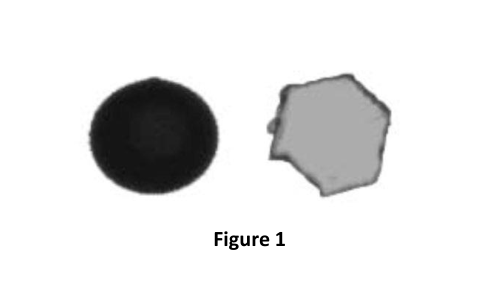
Figure 1: A spherical particle (left) and a flat disc particle (right). Both produce similar equivalent spherical diameter results, but their true geometries — and their behavior in a manufacturing process — are entirely different.
In a real manufacturing context, these two particles would flow differently, pack differently, and interact differently with other process components. A shape measurement that cannot tell them apart provides no useful process control information.
Random Orientation in Practice
Figure 2 shows thumbnail images of a crystal-like sample that is flat and hexagonal in shape, analyzed using the Raptor BenchTop Dynamic Image Analyzer, which is designed for random particle orientation and recirculates the sample during analysis.
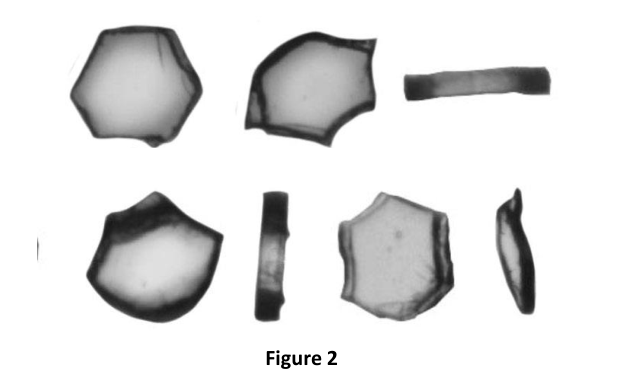
Figure 2: Thumbnail images from a Dynamic Image Analysis run on flat hexagonal crystals. Random orientation allows all particle dimensions to be captured — not just the largest face. Notice the variety of orientations represented across the thumbnail grid.
The thumbnails show the crystals presenting in multiple orientations: some showing their full hexagonal face (appearing large and flat), others presenting on edge (appearing narrow and elongated). This is exactly the kind of variation that a static image analysis system or microscope would suppress — and exactly the variation that matters for understanding how these particles will behave.
Statistical Results
Figure 3 shows the plotted size distribution for the crystal sample.
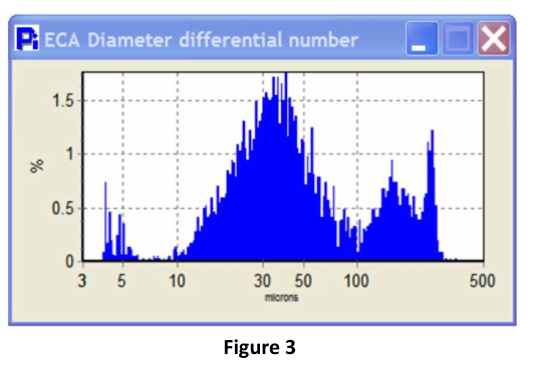
Figure 3: Size distribution results for the flat crystal sample. The peaks above 100 μm represent particles that presented their largest face to the detector. The population under 100 μm represents the same particles captured in other orientations — showing their true dimensional range rather than just their maximum projected area.
This bimodal character is only visible because random orientation was used. A forced-orientation system would collapse this distribution into a single peak at the largest face dimension, losing the information about true particle thickness and aspect ratio entirely.
Why Recirculation Matters
Random orientation and sample recirculation work together. Recirculation ensures that each particle passes through the detection zone multiple times in multiple orientations, building a statistically representative picture of the population. This is the same principle that underpins laser diffraction as a process control standard — and it is equally important when the measurement goal is shape rather than size.
Without recirculation, a single-pass image analysis system may capture each particle in only one orientation, partially defeating the purpose of a flow-based measurement.
Conclusion
Accurate particle shape analysis requires that all dimensions of a particle be accessible to the detector — not just the largest face. Static image analysis and microscopy cannot meet this requirement because particle orientation is controlled by gravity, not by the instrument.
The Raptor BenchTop from Vision Analytical employs both random orientation and sample recirculation to ensure that size and shape data represent a true cross-section of the particle population. As shown in this application, the difference between a forced-orientation and a random-orientation measurement is not cosmetic — it determines whether the data can be used for meaningful process control.
For related applications where particle shape directly impacts process performance, see AN-001 Fiber Particle Shape Analysis and AN-015 Particle Shape Analysis of Polystyrene Spheres.